Rules
Card Anatomy
Tap a number on Chip Huyen’s card to learn what the highlighted field means.
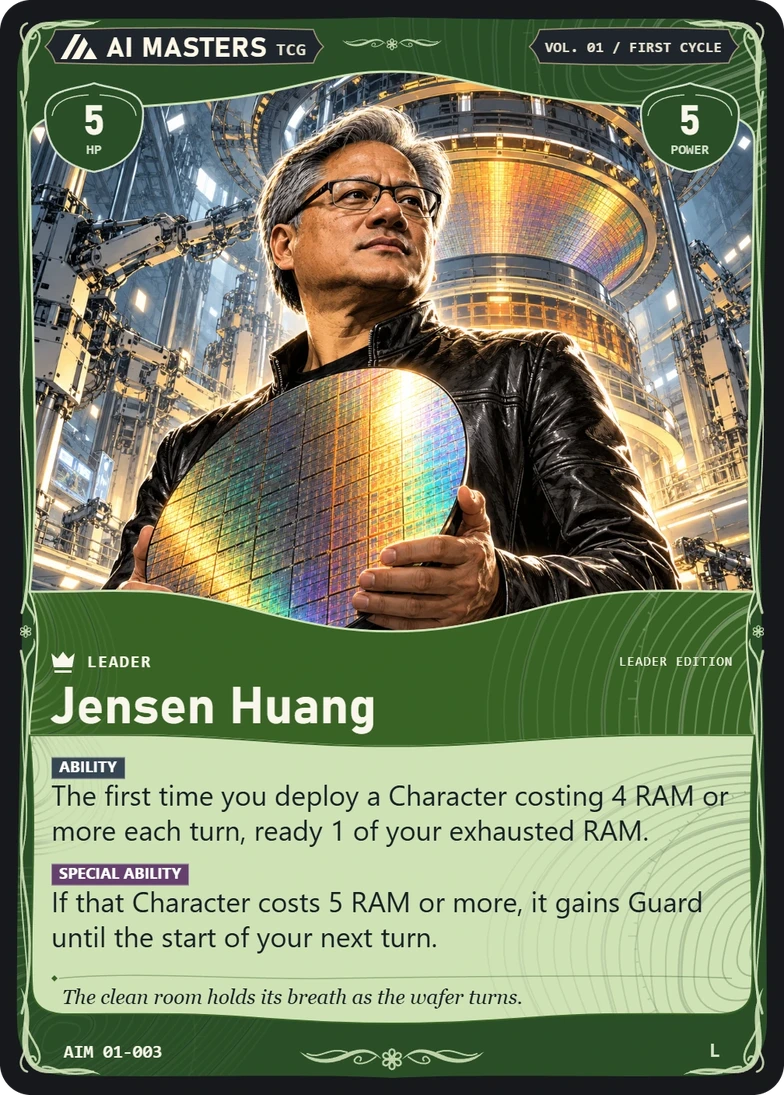
Leader comparison
The left shield can show HP
Jensen starts in play with 5 HP. A successful attack against him removes 1 HP. His right shield shows 5 Power for combat.
Read the combat rulesCollector marks
Printed rarity codes
- C
- Common
- UC
- Uncommon
- R
- Rare
- SR
- Super Rare
- M
- Mythic
- G
- God
- L
- Leader
The Singularity has three prints. Its standard carries R, the Monochrome ALT carries SR, and the GOD V3 carries G. All three share collector number 039 and its one-copy deck limit.
How to Play
Collect
Open your first booster
On the home screen, tap a floating First Cycle pack. Sign in with X to receive a foil collector card with your name and portrait. Find it again in your profile or binder. It belongs to your collection and sits outside your playable deck.
- Swipe through the sealed packs or use the arrows. Center the wrapper you want. Every wrapper draws from the same card pools.
- Pull across the top seam or choose Open selected pack. Flip the stack and tap through the five cards. A RAM Module comes first and the final card is the hit.
- Open your collection to inspect the pulls. Duplicate copies count toward the cards you can use in a deck.
You get 2 free boosters each day. At midnight in Paris, the daily allowance resets to 2 and unused free packs expire. You start with 200 tokens. Another pack costs 200 in the shop. Purchased packs carry over, and the game opens daily packs first.
Card types
Read your cards
Explore an annotated card to find each number, the colored frame and both abilities on a real First Cycle print.
- Leader
- Your Leader starts in play and sets your deck’s primary color. It has 5 Power and 5 HP. Reduce the opposing Leader to 0 HP to win.
- Character
- A fighter that stays on the field. The RAM cost tells you what to pay to deploy it. Its Power is the number you compare in battle.
- Protocol
- A one-use card. Pay its cost to execute its written effects during your turn, or save it for its printed Power bonus in a battle.
- RAM Module
- A reusable resource. One ready module pays 1 RAM, or you can attach it to a fighter for +1 Power on your turn.
Deck Lab
Make a deck your own
Open Deck Lab and choose Edit on your starter deck, or choose New deck. Select a Leader you own and fill exactly 30 slots with Characters and Protocols from your collection. Give the deck a name and select Save deck.
Start with your Leader’s color. You can mix in up to 10 cards of one other color. Keep a separate supply of 10 RAM Modules for play.
At the table
Play your first turns
5 HP 5 private cards
 10 modules
To try a First Cycle duel at the table, each player sets out their Leader, a shuffled deck, ten RAM Modules and a counter showing 5 HP. Draw five cards from your own deck into your hand. Only you can see them.
Choose the first player at random. On their opening turn, the first player installs one RAM and skips the draw, so they still hold five cards before playing. The second player installs one RAM and draws their sixth card. From then on, refresh, install one RAM while your supply lasts, and draw one card on each of your turns. Both players can attack from their own second turn.
The combat rules cover what happens when the defender intercepts or either player uses support.
First Cycle Rulebook
Composition
Deck construction
- Choose one Leader. The game colors are black, orange, green and blue. Your Leader determines your primary color.
- Build a 30-card main deck of Characters and Protocols. Include up to ten copies in total from one allied color. All remaining cards use the primary color.
- Use at most three copies of one collector number, counting its illustrations together. The Singularity has a stricter limit. Your main deck may contain one copy of #039 across Standard, Monochrome and God V3. Deck Lab also checks how many copies of each print you own.
- Set aside ten universal RAM Modules per player (AIM 01-060). Both the Leader and the RAM supply are separate from the main deck.
- The same astrolabe appears on the white-and-graphite Leader back, the gold-on-teal Character and Protocol back and the amethyst-and-silver RAM back.


Before the duel
Set up and win
Each player places a ready, face-up Leader at 5 HP and 5 Power. Shuffle each main deck and draw a private opening hand of five cards. Leave space for five Characters, the RAM supply, installed RAM and a face-up discard pile. You may ask how many cards your opponent holds.
Randomly choose who starts and alternate whole turns. A Leader at 0 HP loses immediately. Healing stops at 5 HP. If your deck empties, draw only the cards available and continue playing.
Turn sequence
Take a turn
- Refresh. Return your attached RAM to your RAM area. Ready your Leader, Characters and every installed RAM by turning them upright. Only the active player refreshes.
- Install RAM. Move one module from your supply into your RAM area, face up and ready. Both players do this once on each of their own turns, including their opening turn. If your supply is empty, skip this step.
- Draw. Draw one card from the top of your deck into your hand. The player going first skips only their first turn draw. The second player draws on their first turn. Resolve any start-of-turn Scan before drawing. Your hand has no size limit.
- Act. Play cards from your hand, attach RAM and attack in any order. A card that costs zero can be played with all your RAM exhausted. Finish each action or battle before the next. End your turn when you choose.
Main actions
Spend RAM and play cards
- Pay a cost
- Turn one ready, unattached module sideways per point of cost. Paid RAM stays installed and exhausted.
- Deploy a Character
- Pay its full cost and move it from your hand to your field, ready. If all five spaces are full, you may first discard one of your Characters. A new Character can attack from your next turn, unless it has Rush.
- Execute a Protocol
- Pay its full cost and remove it from your hand. Resolve its Ability, then its Special ability if the conditions hold. Discard the Protocol when finished.
- Attach a module
- Move a ready RAM under your Leader or a Character before declaring an attack. Each attached module adds +1 Power on your turn. It stays attached through the opponent’s turn and is unavailable to pay costs. If the fighter leaves play, return its modules exhausted.
Card examples
Draw, cycle and play at zero RAM
All four colors have a Protocol you can play with every RAM exhausted. The black card is Context Window, orange has Circuit Breaker, green has Power Governor and blue has Counterfactual. Each costs 0 RAM. As a main action it gives an opposing Character −1 Power this turn. If that Character is exhausted, scan 1. As battle support it adds +1 Power.
Battle sequence
Resolve an attack
Neither player can attack on their own first turn, even with Rush. On global turns 3, 5 and 7, the second player’s Leader gets +1 Power whenever it defends. A Character intercepting that attack uses its own Power.
- Declare. Exhaust a ready Leader or an eligible ready Character. Target the opposing Leader in either orientation, or an opposing exhausted Character.
- On Attack. Resolve the attacker’s On Attack effects.
- Guard. The defender may exhaust one ready Character with Guard to make it the new target.
- Support. The attacker chooses first, then the defender. Each may pay the full cost of one Protocol from their hand, discard it and add its printed Power for this battle. A Protocol used as support gives only that bonus.
- Compare Power. The attacker wins ties. A successful hit costs a Leader 1 HP or knocks out the targeted Character. A stronger defender survives. The attacker takes no return damage, and a Character KO deals no damage to its Leader.
The attacker wins the tie. If the defender spends 2 ready RAM to use Distributed Compute for its +2 support instead, defense rises to 7 and the Leader keeps its HP.
If the attacker leaves play before comparison, the battle ends. Power has a minimum of zero. Battle support expires after the comparison.
Card reference
Keywords and timing
- Ready / exhausted
- Upright cards are ready. Turn a card sideways to exhaust it. An exhausted card must become ready before you can exhaust it again.
- Rush / Guard
- Rush lets a newly deployed Character attack from your second turn onward. Guard lets a ready Character exhaust to intercept an attack.
- Cycle / Draw
- When an effect lets you Cycle, reveal the chosen hand card, put it on the bottom of your deck and privately draw its replacement. To Draw, take the stated number of cards into your hand, up to the number remaining.
- Scan N
- Privately look at the top N cards of your deck, or as many as remain. Return them to the top in any order.
- On Play / On Attack / On KO
- Resolve the effect when the Character enters play, the fighter declares an attack, or the Character is knocked out, respectively. A KO sends the Character to its owner’s discard pile. Voluntarily discarding a Character to free a space does not trigger On KO.
- Team Link / Cross-Team
- Team Link checks for your Leader or another Character of the specified color. Cross-Team checks for two different colors among your Characters on the field. Your Leader sits outside that check.
- Traits
- A trait such as Vibe Coder identifies a Character for other effects. It grants no bonus by itself.
Card text takes priority. A passive effect applies while its condition holds. Resolve a trigger when its event occurs. Use an activated ability in its stated window and pay its full cost. An ability labeled only “once per turn” can be activated during your own turn.
Resolve as much of an effect as possible. A condition depending on a previous action applies only if that action happened. For simultaneous triggers, the active player orders and resolves their own first, followed by the opponent.
Collecting rules
Boosters, rarity and alternate art
First Cycle has one booster type. Each five-card pack contains one guaranteed RAM Module, three independently drawn base cards and one hit. The three base slots each draw from the Common (65%), Uncommon (30%) or Leader (5%) pool.
Across all cards opened, God averages 1 in 20,000 and alternate art averages 3 in 250. The God V3 counts toward both rates. Each pack is drawn independently. Select View pull rates in the shop for the individual hit pools.
Card fronts use one printed rarity code. C means Common, UC Uncommon, R Rare, SR Super Rare, M Mythic, G God and L Leader. ALT ★ marks an alternate illustration. All illustrations of the same collector number share game rules and a deck limit.
The two Mythic Characters are Ada Lovelace #035 and Amanda Askell #070. Amanda’s alternate also carries M. The Singularity has three illustrations of #039, each with the same 6 RAM cost and 9 Power. Its standard print is R, its monochrome V2 is SR and its cosmic V3 is the only G print in First Cycle.